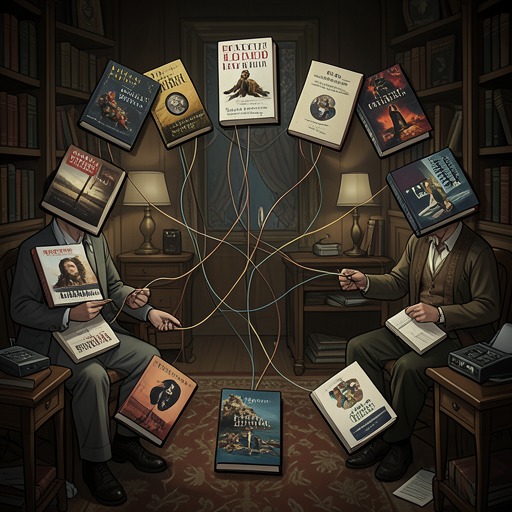
Golden Age of Science Fiction
Science Fiction, Fantasy and Horror Genre and Rating GuideGolden Age of Science Fiction is presented as a literary-historical category rather than as a fictional person, place, or event. In the supplied guide, it functions as the title of a study-oriented entry and as a reference point for organizing science fiction within a broader map of speculative and popular genres. The surrounding catalogue shows the term operating through classification, comparison, and the reception of representative works rather than through a single continuous story.
Definition and Classification
The guide’s genre-and-rating system distinguishes several categories by compact codes. Science fiction is marked SF, while related categories include scary horror, shootist fiction, sorcery fantasy, supernatural fantasy, sleuth fiction, spy fiction, study, superhero fiction, and swords. The system therefore places science fiction within a network of neighboring modes instead of treating it as an isolated label. The presence of both sorcery fantasy and supernatural fantasy is especially important: fantasy is divided internally, while science fiction remains one member of a larger taxonomy of imaginative writing.
The entry’s own code is ST-X-4.0, identifying it as a study with an X-marked classification and a four-star rating. The same catalogue also marks Isaac Asimov’s The Golden Age Of Science Fiction as ST-X-4.0 and FREE. That parallel links the historical subject to a specific bibliographic treatment of it: the Golden Age is approached through study and reference material, while an associated Asimov entry supplies a named literary frame for the period. The rating indicates the guide’s positive assessment, but the evidence does not define the boundaries of the period by dates, authorship, or a fixed canon.
Relation to Science Fiction
The guide explicitly defines SF as Science Fiction, making the genre’s full name part of its organizing apparatus. Other listed entries show how broad the science-fiction field is. Stephen Baxter and Arthur C. Clarke’s The Full Story Of the Firstborn Assault On Mars is classified SF-S-4.0 and marked FREE, placing a planetary assault narrative within the science-fiction section. Orson Scott Card’s Ender’s Game receives several forms of classification, including SF-N-5.0, SF-E-4.0 for Ender’s Game 1, and SF-S-4.0 for another listing. The repeated appearance of the same title under different codes demonstrates that the guide can treat a work through more than one bibliographic or formal lens rather than assuming a single immutable category.
Greg Egan’s Diaspora is listed as SF-N-4.0, while David G. Hartwell and Kathryn Cramer’s The Ascent of Wonder The Evolution of Hard SF is marked SF-A-5.0. Together, these entries connect the Golden Age concept to both creative science fiction and critical or historical discussion of hard science fiction. The catalogue thus suggests a tradition shaped not only by novels and stories but also by attempts to define, explain, and evaluate the genre’s changing forms.
Boundaries and Neighboring Genres
The surrounding classification makes genre boundaries visible. Science fiction appears beside supernatural fantasy, sorcery fantasy, scary horror, sleuth fiction, shootist fiction, spy fiction, and superhero fiction. The superhero category is represented by the SF-N-3.0 listing for John Scalzi’s The Android’s Dream, while other entries in the larger guide use the same system to distinguish forms that may overlap in readership, subject matter, or speculative premise. Such juxtaposition makes classification itself part of the subject: the Golden Age is understood through the distinctions a guide draws between science fiction and its neighbors.
Those distinctions are functional rather than absolute. The listed works include planetary conflict, speculative science, genre history, and narratives that may be marketed or discussed through multiple categories. The evidence does not establish a detailed theory of crossover, but it does show that the guide’s system accommodates variation in form and emphasis. Its categories provide a practical vocabulary for comparing texts while the repeated codes and adjacent labels reveal that literary identity can depend on how a work is presented as much as on its basic plot premise.
Critical and Historical Significance
The pairing of Golden Age of Science Fiction with Asimov’s The Golden Age Of Science Fiction makes literary history the central concern of the entry. The subject is not merely a list of celebrated stories; it is a period-oriented idea that the guide isolates for study. The four-star classification places that study on the same evaluative level as the associated Asimov entry, suggesting that historical interpretation and primary creative work are being valued together.
The broader catalogue also includes works by Kingsley Amis, Isaac Asimov, Stephen Baxter and Arthur C. Clarke, Orson Scott Card, Greg Egan, David G. Hartwell and Kathryn Cramer, Wil McCarthy, and John Scalzi. These names span criticism, historical commentary, planetary adventure, military or strategic science fiction, mathematically oriented speculation, and contemporary genre fiction. On the available evidence, the Golden Age therefore serves as a historical lens through which science fiction can be organized and reconsidered, not as a narrowly defined period whose complete chronology or membership is supplied here.
Place in the Guide
As a study entry, Golden Age of Science Fiction helps turn the catalogue from a simple list of titles into a map of literary categories and traditions. Its placement among entries that identify science fiction, fantasy, horror, detective fiction, and superhero fiction emphasizes the guide’s dual purpose: it recommends individual works while also teaching readers how those works are grouped.
The FREE marker attached to Asimov’s related entry adds an access dimension to that historical framing. The guide simultaneously records genre, form, rating, and availability, so the Golden Age is presented through both literary value and practical discoverability. Its decisive role is consequently organizational and interpretive: it names a tradition, gives that tradition a study framework, and places it within a comparative system capable of recording works with different forms, emphases, and classifications.